Let's be honest—most of us have been vibe coding. You know the drill: throw a prompt at Claude or Copilot, cross your fingers, paste whatever comes back, and pray it works. When it doesn't, you throw another prompt at it. Rinse, repeat, spiral into frustration.
I was doing this too. And it kind of worked. Until projects got bigger, context got lost, and I found myself debugging AI-generated code that even the AI couldn't remember writing.
So I changed my approach. I stopped treating AI like a magic code printer and started treating it like a junior developer who's brilliant but has amnesia. The shift? Going from "vibe coding" to what I'm calling Systematic Agent Orchestration.
Here's what that actually looks like.
You're Not a Coder Anymore. You're an Architect.
This was the mindset shift that changed everything for me.
I used to think working with AI meant I could skip learning how systems work because the AI "knows" it. Wrong. What actually happens is you become a systems thinker—someone who understands how the frontend talks to the API, how the API hits the database, how auth flows through the whole thing. You just don't have to remember the exact syntax for a Prisma query anymore.
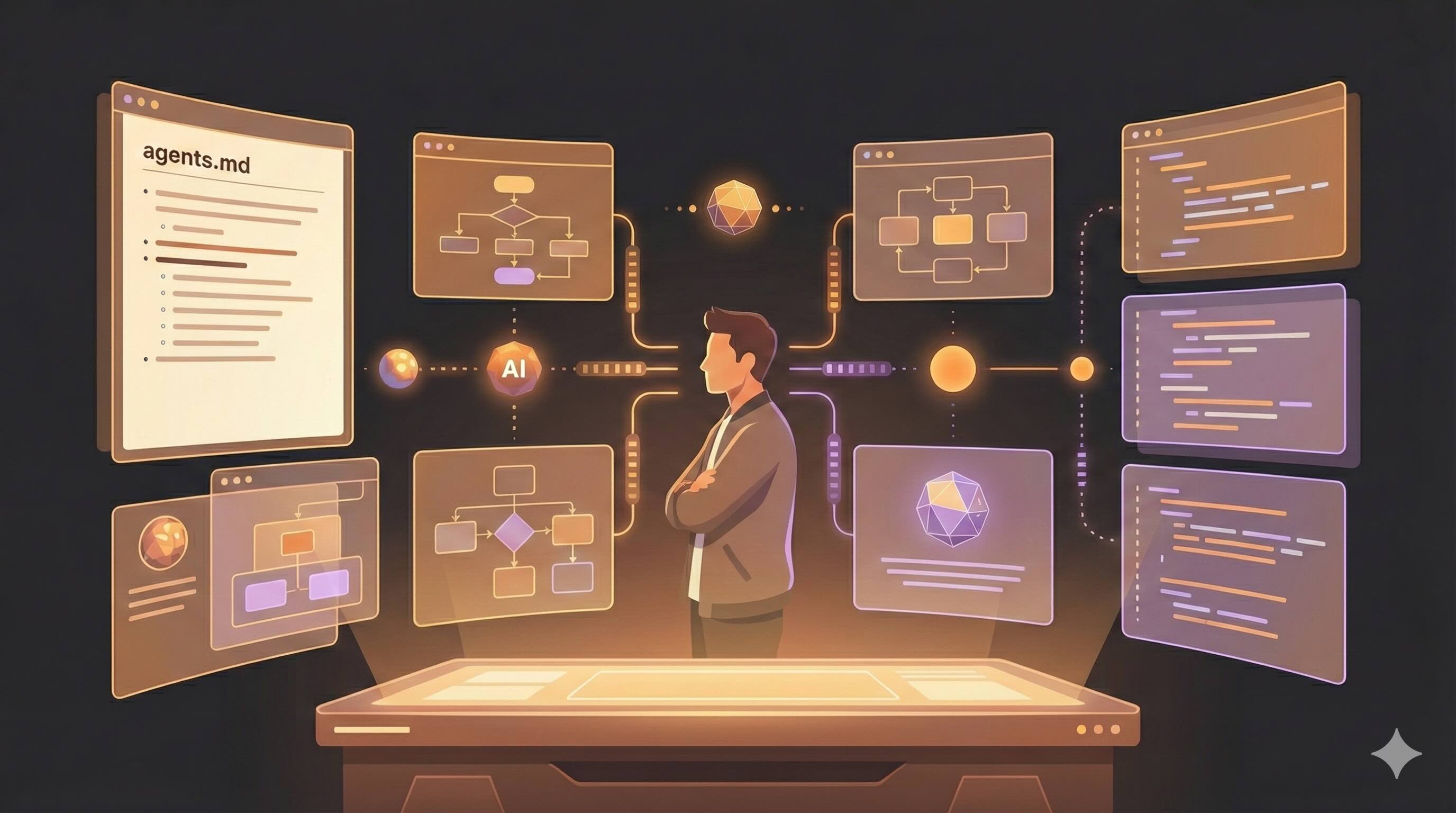
Think of your app's components as no-code blocks. Your job isn't to write the code inside each block—it's to understand how data flows between them. The AI handles the syntax. You handle the architecture.
This is a better division of labor than you might think. LLMs are great at boilerplate, syntax, and pattern matching. They're terrible at understanding your actual product requirements and making tradeoffs. That's still your job.
The Two Modes: Spec vs. Build
Here's my biggest workflow change: I now explicitly separate thinking from doing.
Spec Mode is where I slow down. Before the AI writes a single line of code, I'm asking questions:
- "Why are you reaching for this framework?"
- "Walk me through how this data gets from the form to the database."
- "Is there a simpler way to do this with fewer dependencies?"
I'll often ask the agent to write a plan.md or technical spec first. Just a document explaining what it's going to build and why. You'd be surprised how often the AI's first instinct is to reach for some overcomplicated solution when a 50-line vanilla implementation would work fine.
Build Mode only starts once I've reviewed the spec and actually understand what's about to be generated. This sounds slow, but it's actually faster—because you're not debugging mystery code later.
The irony here? Frameworks exist largely to help humans manage complexity. But AI doesn't need those human-centric crutches. Sometimes the AI can write simpler, lower-level code precisely because it doesn't get tired or confused by boilerplate. So don't let it default to the "standard" stack just because that's what the training data looked like.
The agents.md File: Your AI's Persistent Memory
Here's a trick that saved my sanity: I keep an agents.md file in my project root. It's basically a README, but for the AI.
Every time I start a session, I feed this file to the agent first. It includes:
- My preferences: "Always use TypeScript. Prefer Tailwind. Keep dependencies minimal unless there's a strong reason not to."
- My workflow rules: "Create a PR before merging. Write tests for any logic-heavy function. Never commit directly to main."
- Project context: A brief summary of what this thing actually does, what stage it's at, and any quirks or decisions I've already made.
This solves the amnesia problem. Instead of re-explaining my entire setup every session, I just point to the file. The agent shows up to work already briefed.
You can get fancier with this—some people maintain different instruction sets for different agents or project types. But even a basic version pays for itself immediately.
Feed It Real Documentation
This one's embarrassing in hindsight, but I used to just... trust the AI's internal knowledge. "It was trained on the internet, it probably knows the Stripe API, right?"
No. Or at least, not the current version of the Stripe API.
LLMs are trained on snapshots of documentation that might be 6 months to 2 years out of date. When you're using a specific library or API, don't rely on the model's memory. Paste the actual docs. Link to the current GitHub README. Copy the relevant section from the official reference.
This is annoying, but it prevents the most frustrating class of bugs: "hallucinated" syntax that looks right but doesn't work because the API changed eight months ago.
Testing: Your Safety Net for AI Sloppiness
Let me be blunt: AI writes silly bugs. The kind of bugs that a developer with two years of experience would catch immediately—off-by-one errors, missing null checks, incorrect assumptions about async behavior.
The fix? Make testing non-negotiable.
I've added this to my agents.md: "Write tests first for any logic-heavy function." This isn't TDD religion—it's pragmatic. When the AI has to write a test before the implementation, it's forced to think through edge cases. It verifies its own logic before I even look at the output.
Does this catch everything? No. But it catches the easy stuff, which is exactly the stuff AI tends to mess up.
Bonus: Coding Away From Your Desk
One unexpected benefit of this workflow: I can actually direct projects from my phone now.
The setup is simple:
- GitHub's mobile app (or tools like Droid) let me review PRs and leave comments
- I have a dedicated Slack channel for each active project where the CI/CD pipeline posts updates
- For quick fixes, I can open an issue on mobile and let the agent pick it up
I'm not writing code on my phone—that sounds miserable. But I am able to keep projects moving. Review a PR while waiting for coffee. Approve a merge from the train. It's surprisingly effective once your workflow doesn't require you to be the one typing the code.
The Actual Shift
Here's what I've realized: the skill isn't prompting anymore. It's orchestration.
You're not trying to write the perfect prompt that makes the AI do everything perfectly. You're setting up systems—persistent context, spec reviews, testing requirements, documentation pipelines—that make the AI's output consistently usable.
It's less "vibe" and more "process." And honestly? It's made me a better engineer. I think more about architecture now. I ask better questions. I'm more skeptical of default choices.
The AI handles the syntax. I handle the system. Turns out that's a pretty good split.
If you're still vibe coding, try adding just one thing from this: the agents.md file. Start there. It takes 20 minutes to set up and it'll change how you work with AI tools immediately.